
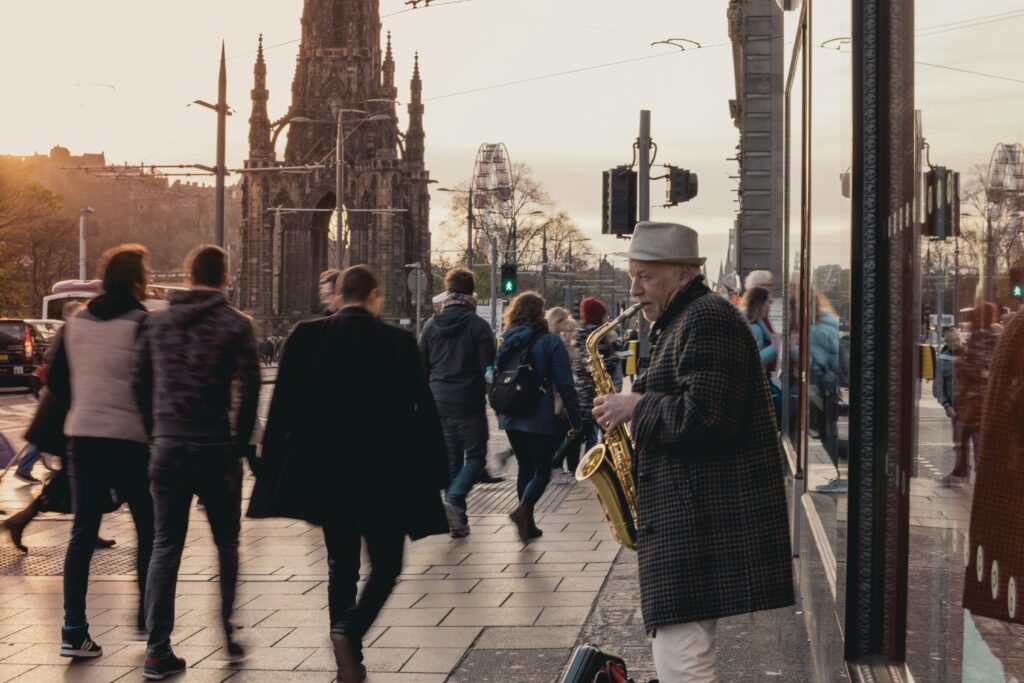
The future will be shaped. The only question is whether we choose to shape it ourselves – or leave it to others?
The Age We Are In
The world is changing at a frightening speed and the United Kingdom is not keeping up.
Technology is remaking our economy, our work, our security and the way we relate to one another. Artificial intelligence is shifting where power lies faster than our institutions can follow. Climate pressures are mounting. War has returned to Europe. Economic shocks travel further and faster than before. A small number of global companies now exercise influence over information, technology, markets and public life at a scale once associated only with states. Among the strongest forces affecting us all is a demographic transformation: our population is ageing, fewer people feel able to start a family and the burden of care and pensions falls on a shrinking working population. And the public finances are under real strain, with the cost of
borrowing increasingly competing with vital investment.
The strain is showing. Governments put off hard choices. Public debate descends into outrage and fatigue. Trust in institutions drains away. Long-term problems are left to grow while politicians reach for the quick fix.
People feel less safe. Many no longer believe their children will inherit a better life than their own.
The world is now moving faster than our democratic institutions can adapt. Things cannot continue as they are. So one way or another, change is coming. The only question is whether we shape what comes next.
That is the challenge at the heart of this work.
The Democratic Challenge
For most of its history, our democracy answered a single question: who governs?
Today we face a harder one: how do we govern well in a world that is fastmoving, complex and competitive?
How does our free, democratic society make – and stick to – the difficult decisions needed to thrive?
In its present form, our democracy is failing to answer that question consistently. Politicians need votes. Markets pursue profit. Our media competes for attention. Yet our country’s success depends on seeing reality clearly, weighing hard choices honestly, deciding on a course of action and holding to that direction over time. A country holds together while enough people believe power is being used in the interest of society as a whole. When that belief is lost, consent, cohesion and confidence drain away.
Democratic renewals on the scale now required have usually come only after catastrophe forced them. The aim here is to begin that renewal by choice rather than waiting for crisis to make it unavoidable.
The Future We Face:
The UK has many strengths. Talented people. Strong universities and businesses. Scientific excellence. A long democratic tradition. Deep reserves of civic energy and public spirit.
Those strengths do not spare us from reality — we must still adapt to change, live within the limits of our physical world and support future generations. But they do give us the means to face it. We can still build a country where the young can afford homes, start families, build stable lives and expect their prospects to improve; where technology strengthens society rather than fraying it; where the basics simply work; and where people are proud of what they are and what they will pass on. Whether we do so depends on what we choose to do next.
We will not get there through hope, denial or nostalgia. We might draw inspiration from the past. But the future is ours to face — and ours to shape.
Shaping that future demands honesty about the challenges ahead. It depends on informed debate, big decisions and a commitment to do what it takes to make them happen — decisions about energy, housing, defence, technology, pensions, care, education and economic security, and on the kind of society we mean to be. Decisions made harder by some of the very conditions we must overcome — fractured institutions, an eroded tax base, a degraded public debate.
Today the UK has no dependable way to make choices of this scale together — or to sustain them once made. That is the gap at the heart of our national life.
What Must Change
We all share responsibility for helping to shape our future. This cannot be left to governments, markets or institutions alone.
It starts with building a shared understanding of reality — the pressures reshaping our country and the choices they demand. From there, we must create a way to work through those choices together, shape a long-term course of action, and mobilise our strengths and resources towards shared goals – sustaining effort for long enough to make a difference.
No part of our democracy is designed to help society act in its own long-term
Where We Start
The gap at the heart of our democracy is the absence of a shared home for this work an institution solely devoted to the long-term public good. The Institute for our Nation will help restore society’s ability to shape its future deliberately. It will be established to serve not this government or the next, but the long-term interests of all of us.
It would not chase votes, profit or attention. It would be part of our country itself and aim to reflect fairly every part of society — a place where knowledge, open debate and strategic thought meet, so that the public’s considered judgement about our future can be heard and acted on.
Crucially, it would hold no power of its own. It could not legislate, tax, spend or compel anyone to do anything. Its task is not to govern but to help our country see clearly and decide for itself. The decisions, and accountability for them, would remain exactly where they belong: with elected politicians, and with the voters who choose them. And to be worthy of trust, it would be guided by the Founding Commitments published alongside this Charter — independent, accountable and built to last.
The Plan
The National Strategy Project will help the country develop a clear account of the future it wants and how to make it happen. The work moves through three stages.
First, shared knowledge. A series of clear documents will set out the major realities, risks and choices facing the United Kingdom as honestly as possible. They will show where serious and well-informed people disagree, and will be published openly for anyone to test, challenge and improve. The aim is not a single official version of the truth, but a transparent, shared starting point our country can reason from together — one its critics are invited to question.
Second, the country in one room. A large group of citizens will come together to weigh these realities. They will be selected to represent the public as faithfully as possible. They will hear evidence and arguments from many sides and deliberate on the questions they decide matter most. For the first time, this will uncover where informed public judgement lies — not poll responses to headlines, but a considered view, formed through broad deliberation. It will provide one of the clearest pictures a modern democracy can have of its people’s considered judgement.
Third, national participation. Technology now makes it possible to extend this deliberation to the whole country — reaching into communities, businesses, workplaces, schools, universities, prisons, places of shelter and refuge, and public life. Millions of people will be able to take part, with strong protections for privacy and against manipulation, so that what emerges is a true reflection of our public and not whoever might try to game it. By giving society itself the opportunity to participate in shaping its future, informed public judgement can support informed public consent.
This knowledge and these judgements come together in a national strategy — a clear, public account of what our country says it wants and what it is prepared to accept, ready before the next general election. It binds no one. Any party is free to take it up, adapt it or reject it, and voters — not the Institute — will weigh how well politicians respond. For the first time, political choices can be judged against a shared understanding of the future society wants and what it will take to achieve it.
This will be the first national strategy cycle, not the last. With sustained effort towards shared goals the country has chosen, the big decisions can be taken, the big investments made — and a better future can begin to take shape.
Everyone Has a Role
This work belongs to everyone. No one holds a monopoly on wisdom, and everyone will live with the consequences of what comes next. Different people will have different ideas about the future they want. That is not an obstacle to this work — it is the reason for it.
The UK needs leadership from every place, generation and community: people willing to confront reality honestly, bring others together, navigate disagreement, make difficult choices and sustain effort over time. The National Strategy Project needs people and organisations offering ideas, expertise, partnership, funding and leadership. Schools, universities, businesses, charities, communities, media and citizens all have a part — above all the younger generations whose lives will be shaped most by the decisions we make now.
Because trust must be earned, not assumed, the National Strategy Project has published its Founding Commitments, alongside this Charter. The Commitments cover independence, transparency, accountability and service to the long-term public good. Everyone involved in this work – founders, trustees, staff, advisers, volunteers, partners, funders and supporters – will be expected to uphold them and help hold one another accountable to them.
The future will be shaped. The responsibility for shaping it belongs to all of us.
The National Strategy Project is managed by The People’s Strategy Project Limited, a company limited by guarantee. Registered in England and Wales, Company No.16896349. Registered office: 9 Hare & Billet Road, London, SE3 0RB. The project is independent, non-partisan and committed to serving the long-term public good.